Commercial leasing agent Nairobi: fees, rents and expertise

A commercial leasing agent in Nairobi helps you find premises suited to your business and supports discussions with property owners. Choose an agent whose experience fits your property type, intended use, and preferred locations. This guide explains how to assess an agent and prepare a brief for your commercial property search.
Key Takeaways
- Assess an agent’s experience against your specific property type and the practical demands of your business.
- Understand how location, intended use and lease structure shape the search for suitable commercial premises.
- Comparable deals and client references can help you evaluate an agent’s track record and market knowledge.
- A clear brief on your space, operational needs and preferred terms helps Red Roof Realty guide your commercial leasing search.
Assessing a commercial leasing agent’s expertise in your asset class
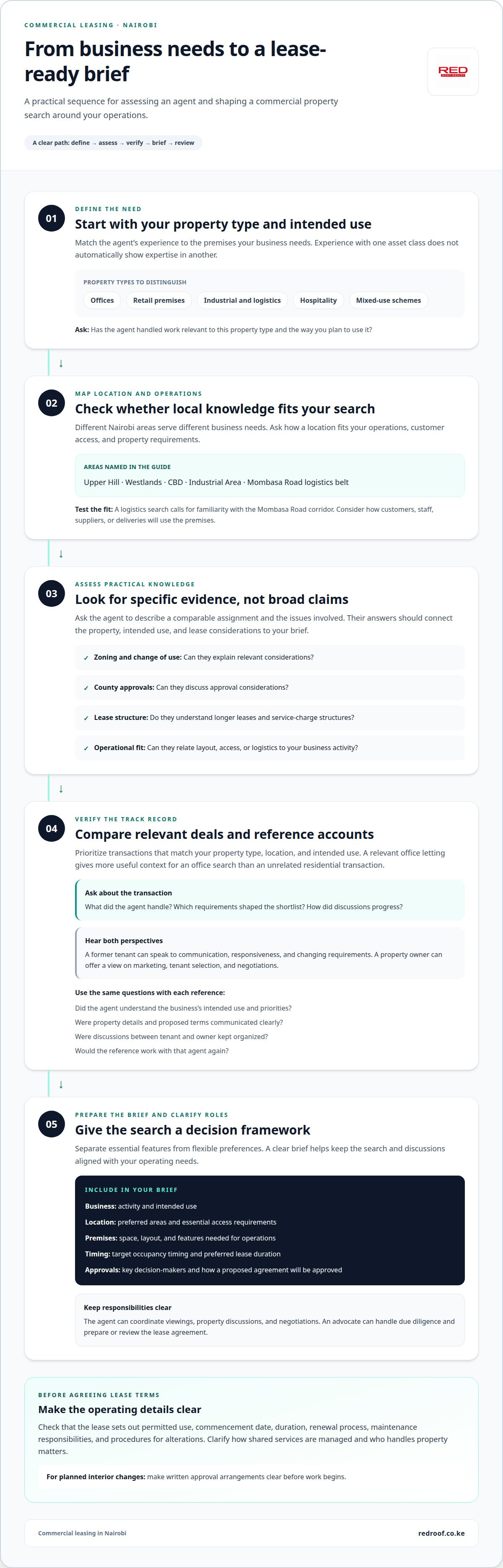
Match the agent’s experience to the property type you need. Commercial property can include offices, retail premises, industrial and logistics properties, hospitality properties, and mixed-use schemes, each with different space, access, and operating requirements. Experience leasing offices, for example, does not automatically demonstrate knowledge of warehouse requirements.
To assess a commercial leasing agent in Nairobi, look for work relevant to your property type and intended use. Review comparable transactions, ask for client references, and discuss the agent’s knowledge of zoning, change-of-use issues, and county approvals.
Location matters, too. Nairobi’s Upper Hill, Westlands, CBD, Industrial Area, and Mombasa Road logistics belt serve different business needs. Ask how each area fits your operations, customer access, and property requirements. A logistics search, for example, calls for familiarity with the Mombasa Road corridor.
During an initial assessment, look for clear answers on these points:
- Relevant experience with your asset class, not commercial property in general.
- Familiarity with areas and business districts suited to your operations.
- Ability to explain zoning, change-of-use, and county approval considerations.
- Understanding of longer leases and service-charge structures.
Look for specific evidence rather than broad claims. Ask the agent to describe a comparable assignment and the issues involved. For an office, that might mean explaining how the layout supports your team. For an industrial unit, ask about loading access and logistics. Office experience alone does not establish warehouse expertise. A suitable agent connects location, intended use, and lease terms to your brief.
Commercial leasing and letting
A commercial leasing agent connects businesses with premises suited to their operations. In Nairobi, a search may involve offices, retail premises, industrial and logistics properties, hospitality properties, or mixed-use schemes. The agent can coordinate viewings, communicate your requirements, and support discussions with the property owner. Each type of property has different practical considerations: a clinic, for example, may need a different internal layout from a customer-facing shop.
Give the agent your intended business activity, preferred areas, space requirements, operational needs, and target occupancy timing. Explain how customers, staff, suppliers, or deliveries will use the premises, and note any access or layout requirements. This helps narrow the search to properties that can support daily operations, not just ones that look appealing.
The lease should set out the permitted use, commencement date, duration, renewal process, maintenance responsibilities, and procedures for alterations. Clarify how shared services are managed and who handles property matters. If you plan interior changes, for example, make sure written approval arrangements are clear before work begins.
An agent can coordinate the process from your initial brief through viewings and discussions with the owner. Keep decisions focused by distinguishing essential features from flexible preferences. A business receiving regular deliveries, for example, may prioritize access arrangements over a particular building style.
A useful letting brief can capture:
- Business activity and intended use of the premises.
- Preferred locations and essential access requirements.
- Space, layout, and property features needed for operations.
- Target occupancy timing and preferred lease duration.
- Key decision-makers and the process for approving a proposed agreement.
With a clear brief, an agent can focus the search and keep discussions aligned with your operating needs.
Commercial real estate agencies in Kenya help businesses and investors lease, buy, sell, and manage commercial property. These transactions can involve longer leases, service-charge structures, and zoning rules, so it is important to understand the terms and responsibilities involved.
Listings illustrate the range of spaces available: a commercial office in Kilimani, Kenya, is listed as a 200 m² property, while a commercial office in Karen, Kenya, has 4,000 square feet of open space. A commercial building in Nairobi, Kenya, is listed for rent at R 23 per ft². A commercial office in Upper Hill, Kenya, has a listed area of 2,595 sq ft.
Comparing an agent’s deals and client references
Ask about comparable transactions and references before appointing an agent. To reduce scam risks, clarify who the agent represents and how property details will be verified. An advocate can handle due diligence and the lease agreement, while the agent supports discussions and negotiations.
Look for transactions that match your property type, location, and intended use. A recent office letting in Westlands, for instance, offers more relevant context for an office search there than an unrelated residential transaction. Ask what the agent handled, which requirements shaped the shortlist, and how discussions progressed.
References can add context beyond a deal summary. A former tenant may describe the agent’s communication, responsiveness, and handling of changing requirements. A property owner may offer a different perspective on marketing, tenant selection, and negotiations. Compare these accounts with the agent’s description of the transaction.
Use a consistent set of questions for each reference:
- Did the agent understand the business’s intended use and priorities?
- Were property details and proposed terms communicated clearly?
- Did the agent keep discussions organized between tenant and owner?
- Would the reference work with that agent again?
Assess the agent’s approach to negotiation. Strong negotiation connects a requested term to a practical business need. A tenant planning a fit-out, for example, may prioritize access timing and clearly defined responsibilities. The agent should explain how proposed terms affect your occupancy plans rather than rely on general assurances.
For a Nairobi transaction, distinguish the agent’s role from the advocate’s. The agent can coordinate property discussions and help you compare options. The advocate handles due diligence and prepares or reviews the lease agreement. Clear roles help document decisions, responsibilities, and agreed terms.
Preparing your commercial leasing brief
A clear brief gives an agent a decision framework, not just a list of preferred buildings. Describe your business activity, why you are relocating or expanding, and what the premises must support. A Nairobi retailer may need customer-facing space, while a distribution operation may prioritize vehicle movement and storage.
List your preferred Nairobi areas and explain why they matter. Consider customer access, staff travel, suppliers, and delivery routes where relevant. If several areas could work, rank them and name acceptable alternatives. This separates essential location requirements from preferences.
Record operational requirements, including:
- Approximate usable space and separation needs for teams, storage, or customer areas.
- Preferred property layout, ceiling height, parking, loading, power, and access features.
- Target move-in timing, preferred lease duration, and flexibility around commencement.
- Fit-out, signage, security, or service responsibilities relevant to the premises.
- Internal decision-makers and the approval process for a shortlist and lease.
Separate non-negotiables from preferences. A business serving customers on site may prioritize visibility and convenient access, while one with dedicated work areas may focus on layout. Note any planned alterations and operational limits that could rule out a property. This keeps unsuitable options from taking priority during viewings.
Share relevant plans, your preferred communication methods, and questions that need the property owner’s input. Identify who will review proposed terms and make the final decision. Limit sensitive business details to what is needed for the search. With these priorities documented, the agent can assess properties against your requirements rather than make assumptions.
Red Roof Realty: Commercial Leasing
Red Roof Realty helps businesses assess commercial premises against their operational needs. Its Commercial Leasing service supports property searches and negotiations, taking you from business requirements to discussions about suitable properties. Turn to the team when you need help identifying premises or coordinating lease negotiations.
Start with your intended use, preferred locations, space requirements, and timing. Red Roof Realty uses these priorities to guide the search and keep discussions relevant to your business. For an office, team workflow and customer access may shape suitability; for a warehouse, deliveries and movement through the space may matter more.
Red Roof Realty has supported business expansion through commercial leases. Mia Duck appointed the company to secure locations for two new branches in Mlolongo and Kitengela. This example shows how a leasing brief can focus on premises for specific business locations, not simply on finding available space.
Other property needs may call for different services. Property Management supports owners managing their assets, while Residential Property Sales serves people buying or selling homes. Let your immediate objective guide the conversation.
To make your first discussion productive, share your business activity, location priorities, operational requirements, and preferred lease terms. Clear priorities help focus the search and discussions on what your business needs from its premises.
Red Roof Realty’s team brings commercial leasing experience to property decisions. Contact Red Roof Realty to discuss your commercial premises requirements.
Frequently Asked Questions
What should an agency agreement clarify in Kenya?
An agency agreement should define the agent’s role, the property or search covered, and how the engagement ends. It should also identify whom the agent represents and how updates will be shared. A tenant seeking office premises, for example, benefits from clear expectations about searches, viewings, and communication with property owners before work begins.
What does a commercial leasing agent in Nairobi do?
A commercial leasing agent in Nairobi helps businesses find premises suited to their operations and coordinates discussions with property owners. The work may include arranging viewings, explaining property details, and supporting the leasing process. If you are opening a customer-facing location, the agent can help focus the search on properties that fit your intended use and preferred area.
Which Nairobi agents work with offices, retail, warehouse, and industrial property?
Choose an agent whose experience and services fit the property type and transaction you need. Red Roof Realty offers commercial leasing for office space and commercial property sales for warehouses. Its wider property activity includes Nairobi, Mombasa, Kiambu, Eldoret, and Kisumu. Clarify the agent’s role so expectations for the assignment are clear.
How are responsibilities agreed in a Nairobi commercial lease?
Record responsibilities in the written lease and make sure all parties understand them before signing. The agreement can clarify permitted use, maintenance, alterations, access, and how to raise property issues. If you plan internal changes, understand the approval process and who is responsible for the work before committing.
What steps does a commercial leasing agent take to lease commercial property in Nairobi?
The agent starts by understanding your business requirements, then identifies relevant premises and coordinates viewings. Once you select a suitable property, the agent can support discussions with the owner and help clarify proposed terms. An advocate can handle due diligence and the lease agreement, keeping legal review separate from the agent’s coordination role.

Frequently Asked Questions
An agency agreement should define the agent’s role, the property or search covered, and how the engagement ends. It should also identify whom the agent represents and how updates will be shared. A tenant seeking office premises, for example, benefits from clear expectations about searches, viewings, and communication with property owners before work begins.
A commercial leasing agent in Nairobi helps businesses find premises suited to their operations and coordinates discussions with property owners. The work may include arranging viewings, explaining property details, and supporting the leasing process. If you are opening a customer-facing location, the agent can help focus the search on properties that fit your intended use and preferred area.
Choose an agent whose experience and services fit the property type and transaction you need. Red Roof Realty offers commercial leasing for office space and commercial property sales for warehouses. Its wider property activity includes Nairobi, Mombasa, Kiambu, Eldoret, and Kisumu. Clarify the agent’s role so expectations for the assignment are clear.
Record responsibilities in the written lease and make sure all parties understand them before signing. The agreement can clarify permitted use, maintenance, alterations, access, and how to raise property issues. If you plan internal changes, understand the approval process and who is responsible for the work before committing.
The agent starts by understanding your business requirements, then identifies relevant premises and coordinates viewings. Once you select a suitable property, the agent can support discussions with the owner and help clarify proposed terms. An advocate can handle due diligence and the lease agreement, keeping legal review separate from the agent’s coordination role.