Understanding Nairobi Office Market

Nairobi’s commercial listings range from 425-square-foot CBD offices to 10,000-square-foot offices at Prism Towers in Upper Hill, with options also available in Westlands. This guide compares locations, office and retail spaces, available sizes, and property types, helping you assess which commercial property to rent in Nairobi fits your business requirements. Consider the space you need alongside the setting and property type as you narrow your options.
Key Takeaways
- Compare office and retail options across Nairobi, including Upper Hill, the CBD and Westlands, to shortlist locations suited to your business.
- Review available space sizes and floor placements to identify a layout that can support your team and daily operations.
- Assess access, visibility, property type and the way your business will use the space before choosing a commercial premises.
- Explore how Red Roof Realty’s commercial leasing service can help you identify and secure space aligned with your business requirements.
Available office sizes
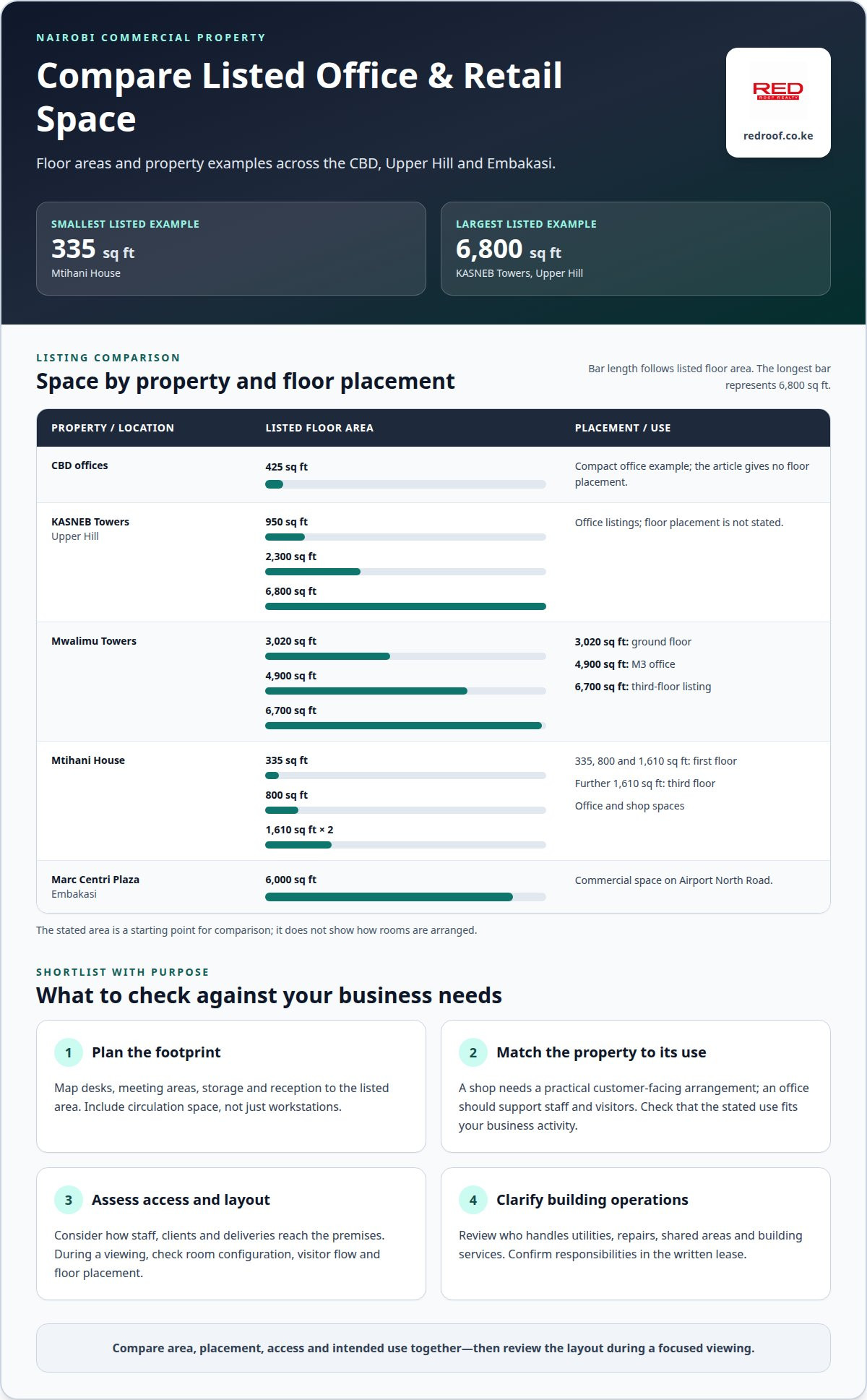
Nairobi office listings span compact suites and expansive floor plates. CBD options start at 425 square feet. KASNEB Towers in Upper Hill lists a 950-square-foot office. Use these examples to match floor area with team size, customer flow and daily work. Headline size alone cannot show whether a property layout supports your operations.
Upper Hill offers several useful size comparisons. Prism Towers lists offices measuring 2,500 and 10,000 square feet. Mwalimu Towers lists 3,020 square feet on the ground floor. Its M3 office measures 4,900 square feet, while the third-floor listing covers 6,700 square feet. These examples show how nearby listings can suit different space requirements.
Use the figures to create a shortlist by function. A 425- to 1,500-square-foot suite may suit a compact operation. The 2,500-square-foot option provides a larger footprint for additional work areas. Listings at 3,020, 4,900 and 6,700 square feet offer room to assess larger requirements. Treat each figure as a size comparison, since layouts vary between properties. The listed area alone does not describe the arrangement of rooms.
Before a viewing, map desks, meeting areas, storage and reception against the listed area. Include circulation space, not only workstations, when estimating what your team needs. Floor placement can shape how the space fits your daily operations. Mwalimu Towers has examples on the ground floor, third floor and M3. Record private-room needs and visitor flow in your shortlist. That brief helps distinguish a compact suite from a mid-sized office or larger floor plate.
Commercial property locations
Nairobi’s commercial districts serve different business needs. The CBD places businesses among established offices and retail premises, while Upper Hill offers an office-focused setting. Embakasi includes Marc Centri Plaza on Airport North Road, an option for businesses seeking space near that corridor. Compare locations based on staff travel, customer access, deliveries and the nature of your business.
Location affects more than the daily commute. A customer-facing business may value visibility and easy access, while an office focused on staff collaboration may prioritise transport connections and a suitable work environment. For retail premises, consider how customers reach the building and find the entrance. For an office, assess how the surrounding area supports meetings, staff access and day-to-day operations.
Before signing, review the lease and confirm that the landlord or agent has authority to let the premises. Check that the permitted use aligns with your business activity, and clarify any county approvals or business permits relevant to your operations. These steps can help identify legal and operational issues before you commit.
The written agreement should clearly state the lease duration, renewal arrangements, utilities and repair responsibilities. Read the specific clauses rather than assuming there is a standard arrangement.
During a viewing, look for access constraints, maintenance concerns, unclear responsibility for shared areas and any differences between the premises and the lease description. In negotiations, clarify permitted alterations, service arrangements and exit conditions. For example, a retail tenant should establish who maintains the shopfront and shared access, while an office tenant should clarify responsibility for internal repairs.
Use location-focused commercial property research to organise your shortlist around access, intended use and operating requirements.
Nairobi commercial office and retail space listings
Nairobi listings include offices and premises suited to retail businesses. Compare each property’s stated use, floor placement and layout with your business activities. A shop needs a practical customer-facing arrangement, while an office should support staff and visitors. Use the listing details to plan a focused viewing.
Office and Retail Options
Mtihani House lists office and shop spaces measuring 335, 800 and 1,610 square feet on the first floor. A further 1,610-square-foot space is listed on the third floor. These examples let you compare different floor placements and configurations within one property. Marc Centri Plaza on Airport North Road in Embakasi lists 6,000 square feet of commercial space. Consider how each option supports customer access, staff activity and your intended use.
Lease Responsibilities
Check the written agreement for responsibilities covering utilities, maintenance, shared areas and building services. Establish which tasks are yours and which remain the landlord’s responsibility. For example, clarify who handles repairs inside the premises and who oversees shared spaces. Record the agreed responsibilities in the lease so both parties can refer to them during the tenancy.
Rental Steps
Start by defining your required property type, preferred location, space needs and operational priorities. Shortlist suitable options, then arrange viewings to assess access, layout and fit for your intended business use. Before signing, review the agreement, including its duration, renewal provisions, service arrangements and repair responsibilities. Resolve unclear wording with the landlord, ensure the agreement reflects what both parties accept, and keep a completed copy. This takes you from a clear business brief to a considered property decision.
Choosing Commercial Space for Your Business
Begin with the work the premises must support. A customer-facing shop needs a clear entrance, visible frontage and room to serve visitors. An office may need quiet meeting areas, private workspaces and a practical reception point. A distribution business has different priorities, including delivery access and suitable storage. Define these needs before comparing buildings.
Assess the layout during a viewing, not just the overall floor area. Walk from the entrance to reception, work areas and shared facilities. Picture a busy working day: where will staff meet clients, store supplies and move between tasks? In a retail unit, consider how shelving or service counters could affect customer movement.
- Access: Consider how staff, clients and deliveries reach the premises.
- Configuration: Check whether the existing rooms support your daily activities.
- Building operations: Clarify how shared areas and building services are managed.
Match the location to how your business serves people. A consultancy receiving scheduled visitors may prioritise straightforward access and a professional reception. A shop may depend more on visibility and convenient customer entry. Consider staff journeys too, especially if employees travel to the premises regularly. These practical details shape how well the location supports daily operations.
Review the written lease alongside the physical space. Confirm the permitted business use, responsibilities for repairs and building services, renewal terms, and any restrictions on alterations. Compare the agreement with what you observed during the viewing. Clear documentation helps align the premises, intended use and both parties’ responsibilities before you commit.
For a considered shortlist and support with commercial leasing guidance, connect your business requirements to suitable premises.
Red Roof Realty: Commercial Leasing
Red Roof Realty helps businesses seeking commercial premises through its commercial leasing service, with searches shaped around operational priorities. Turn to the team when you have a location, property type or space requirement in mind and want guidance through the leasing process.
Start with a clear brief. Set out how you will use the premises, the space your team needs, preferred locations and any access requirements. Red Roof Realty can use these priorities to guide a focused search and help you assess premises against your business needs. This keeps the decision grounded in practical fit, not appearance alone.
As you consider options, Red Roof Realty can support the leasing process and negotiations. Focus discussions on the matters that shape your tenancy, including intended use, lease conditions and responsibilities for the premises. Understanding these points helps you make a considered decision before committing to commercial property.
Your requirements may extend beyond securing premises. Red Roof Realty’s property management can support owners overseeing their property. These services suit different requirements, so the next step depends on whether you are leasing space or managing property.
Red Roof Realty supports businesses seeking commercial leases for their operations. For your search, share the business purpose, preferred setting and essential space requirements. A focused brief gives the leasing discussion a practical foundation and keeps attention on the priorities that matter to your operations.
Ready to discuss commercial premises for your business? Contact Red Roof Realty.
Take the Next Step with Confidence
Turn your business priorities into a clear leasing brief. Identify the intended use, the qualities your team needs each day and the lease conditions that matter to your plans. This gives your search for commercial property to rent in Nairobi a practical direction and helps keep decisions aligned with your operations.
Red Roof Realty offers commercial leasing, residential property sales and property management. For businesses ready to discuss suitable premises and move their search forward, commercial leasing is the relevant next step. A focused conversation can establish what matters most, from the type of space to its intended role in your business.
Share your priorities and take the next step at a pace that suits your decision. Contact Red Roof Realty about available spaces to discuss your commercial property requirements and move forward with clarity.
Frequently Asked Questions
What types of commercial property can businesses lease in Nairobi?
Businesses can consider offices, retail premises and warehouses in Nairobi, as well as commercial options in Mombasa, Kiambu, Eldoret and Kisumu. Choose according to how the premises will function: an office supports staff and client meetings, a shop serves customers on site, and a warehouse supports storage or distribution. Your intended use, access needs and preferred layout can help narrow the property type before you review individual listings.
How should I compare commercial spaces by property type and size?
Compare spaces by usable layout, intended use and the activities they must support. A compact office may suit a small team, while a shop needs customer circulation and room for displays. For a warehouse, consider storage arrangements and goods movement. Review the listed floor area alongside each space’s shape and configuration, since spaces with equal areas can function differently.
Which Nairobi neighborhoods suit offices, retail shops, warehouses and restaurants?
The right neighbourhood depends on who needs to reach your premises and what happens there. For offices, consider staff and visitor access. Retail businesses and restaurants may prioritise customer visibility and easy entry. Warehouse operations often depend on practical delivery access. Compare the CBD, Upper Hill, Embakasi, Westlands, Kilimani, Karen and Industrial Area against your requirements rather than relying on a general ranking.
What commercial properties are currently available in Nairobi?
Listings covered in this guide include offices, shop spaces and other commercial premises in Nairobi. Before arranging a viewing, identify the intended use and the features your operations require, such as customer access, a particular floor arrangement or space for staff activities. Focus on listings that match those criteria so each viewing can answer a specific business question.
How do Westlands, Kilimani, the CBD, Karen and Industrial Area compare for businesses?
Assess each area by business function rather than assuming one is universally suitable. Consider where your customers and staff are based, how clients will reach you, and whether the setting suits daily operations. A restaurant may prioritise customer access, while a warehouse needs practical goods movement. Apply the same criteria across Westlands, Kilimani, the CBD, Karen and Industrial Area to make a useful comparison.
What additional costs should businesses budget for when renting commercial space in Nairobi?
Budget for any applicable service charge; Nairobi CBD office listings have an additional service charge of Ksh 25 per square foot. The deposit, utilities and other lease costs should be confirmed in the written agreement.

Frequently Asked Questions
Businesses can consider offices, retail premises and warehouses in Nairobi, as well as commercial options in Mombasa, Kiambu, Eldoret and Kisumu. Choose according to how the premises will function: an office supports staff and client meetings, a shop serves customers on site, and a warehouse supports storage or distribution. Your intended use, access needs and preferred layout can help narrow the property type before you review individual listings.
Compare spaces by usable layout, intended use and the activities they must support. A compact office may suit a small team, while a shop needs customer circulation and room for displays. For a warehouse, consider storage arrangements and goods movement. Review the listed floor area alongside each space’s shape and configuration, since spaces with equal areas can function differently.
The right neighbourhood depends on who needs to reach your premises and what happens there. For offices, consider staff and visitor access. Retail businesses and restaurants may prioritise customer visibility and easy entry. Warehouse operations often depend on practical delivery access. Compare the CBD, Upper Hill, Embakasi, Westlands, Kilimani, Karen and Industrial Area against your requirements rather than relying on a general ranking.
Listings covered in this guide include offices, shop spaces and other commercial premises in Nairobi. Before arranging a viewing, identify the intended use and the features your operations require, such as customer access, a particular floor arrangement or space for staff activities. Focus on listings that match those criteria so each viewing can answer a specific business question.
Assess each area by business function rather than assuming one is universally suitable. Consider where your customers and staff are based, how clients will reach you, and whether the setting suits daily operations. A restaurant may prioritise customer access, while a warehouse needs practical goods movement. Apply the same criteria across Westlands, Kilimani, the CBD, Karen and Industrial Area to make a useful comparison.
Budget for any applicable service charge; Nairobi CBD office listings have an additional service charge of Ksh 25 per square foot. The deposit, utilities and other lease costs should be confirmed in the written agreement.