
Risks of buying off plan property: What to check before paying

The risks of buying off plan property in Kenya centre on whether the developer can complete the project, how your payments are protected, and whether the finished building will match the plans and images. Delays, financial or management problems, and differences in finishes or design can affect your investment, so attractive renderings alone are not enough to establish a project’s reliability.
A careful assessment starts with the developer’s record, the project’s land and approvals, and the sale agreement. Understand when each instalment is due, whether staged payments depend on construction progress, and what the agreement says about delays and handover.
This guide explains how to assess a developer, understand staged escrow payments, and compare computer-generated images with the completed building. Use it to weigh the documents, payment arrangements, and visual promises before committing.
Key Takeaways
- Assess the developer’s delivery record, financial position, land documentation, and project approvals before committing.
- Read the sale terms closely so payment dates, construction milestones, handover expectations, and delay provisions are clear.
- Understand who controls funds held in escrow and the conditions for releasing each staged payment.
- Compare renderings with written specifications and approved plans to identify what the finished property is expected to include.
1. Is the Developer Trustworthy and Professional?
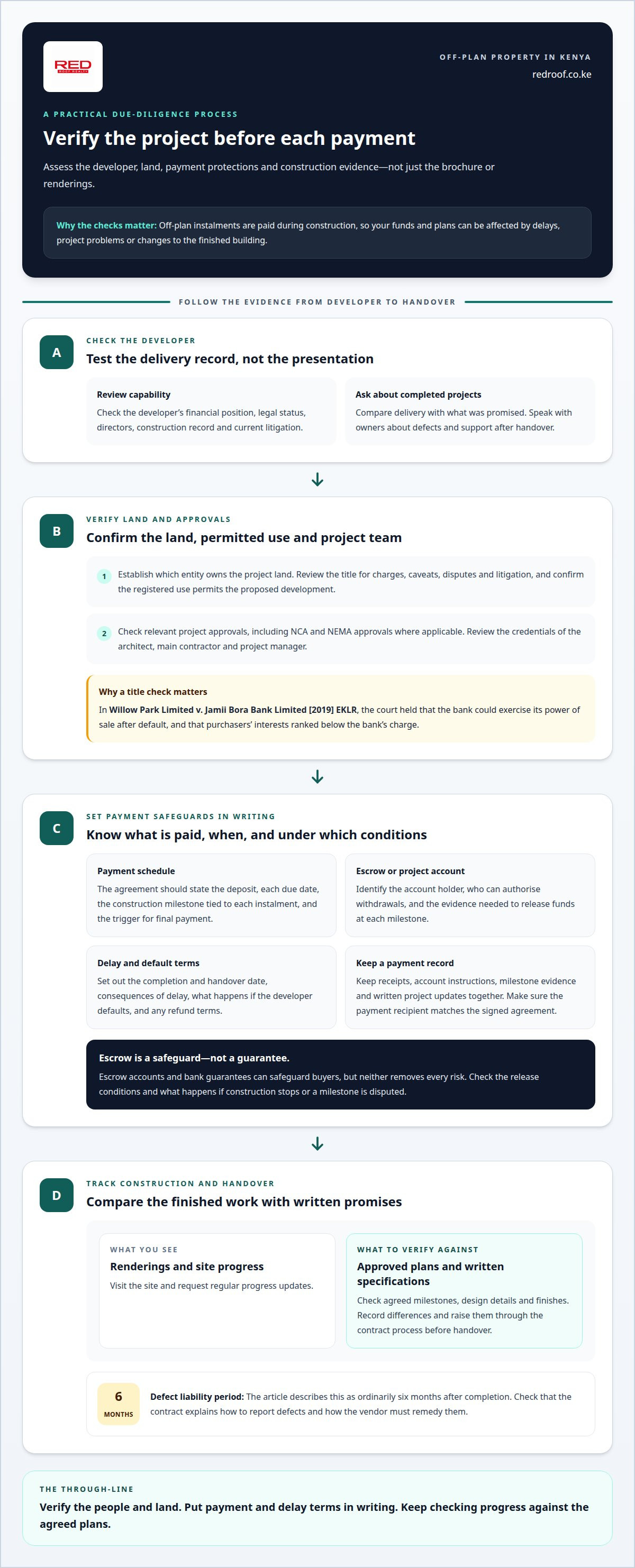
An attractive brochure cannot prove that a developer can complete a project. For an off-plan purchase, assess the developer’s financial position, legal status, directors, construction record, and current litigation. Compare completed projects with promised delivery, then speak with owners about defects and post-handover support. This tests delivery, not presentation.
Land security deserves equal scrutiny. In Willow Park Limited v. Jamii Bora Bank Limited [2019] EKLR, the developer’s land, LR No. Kiambaa/Thimbigua/7186, secured a bank loan. After default, the court held that the bank could exercise its power of sale. It also held that purchasers’ interests ranked below the bank’s charge, so buyers faced exposure despite buying units off plan. The case shows why title encumbrances and loan performance belong in due diligence.
Establish whether the project land is registered to the development company or another responsible entity. Review the title for charges, caveats, disputes, and litigation, and confirm that the registered use permits the proposed residential development. Match the land details to the unit and plans in your contract. This helps clarify what you are buying and which entity is responsible.
Next, review the approvals and delivery team. Confirm relevant project approvals, including NCA and NEMA approvals where applicable, and assess the credentials of the architect, main contractor, and project manager. Visit the site and compare visible progress with the project timeline. Ask for regular updates on progress and use of funds. The developer’s record across completed developments and owners’ experiences can provide practical evidence beyond an attractive rendering.
The contract should set out completion obligations and how defects are reported and remedied after handover. A defect liability period is ordinarily six (6) months after completion, during which the vendor bears responsibility for remedying property defects or damage. Clear procedures make it easier to document a defect and follow the agreed process.
2. Escrow payments and construction-linked milestones
An off-plan purchase usually involves instalments during construction, with the balance due when the project is complete. Buying a completed home does not depend on future construction milestones in the same way. This affects how long your funds remain committed and how the payment plan fits your investment plans. Before committing, read the contract schedule carefully. It should state the deposit, each due date, the milestone tied to each instalment, and the trigger for final payment.
Milestone-based payments can align payment timing more closely with visible progress. An agreement might link an instalment to a defined construction stage rather than a broad calendar period. Ask for the milestone, evidence of completion, and confirmation process to be clearly stated in writing. Escrow or project accounts can reduce the risk of deposits being diverted to other projects. The release conditions matter: specify who authorises each release and which milestone must be met. Escrow is a safeguard, not a substitute for sound contract terms.
Financing problems and regulatory hurdles can delay construction, disrupting plans to rent or resell after handover. Agreements may leave handover dates vague or provide weak remedies for unreasonable delays. Your contract should specify a completion and handover date, explain the consequences of delay, and state what happens if the developer defaults. It may also set out refund terms for inordinate delays or default. If construction stalls, your next steps and payment obligations depend on the written terms.
Market value can shift during construction. If values fall, a lender may reduce or deny financing, leaving you to address a funding gap while still bound by your purchase agreement. Construction changes raise another concern: completed units may have altered designs or inferior finishes. Visit the site, request regular progress updates, and compare the work with the written specifications and agreed milestones. Record differences and raise them through the contract’s process before handover. This review helps you assess construction quality and whether progress matches the project plan.
Off-plan purchases usually involve instalments during construction, with the balance due at completion. Payments for a completed home do not depend on future construction milestones in the same way.
3. Escrow accounts and staged release of deposits
An escrow arrangement can hold a buyer’s deposit until agreed release conditions are met. Before signing, identify the account holder, who can authorise withdrawals, and which project milestones trigger each release. The agreement should explain how funds are handled if construction stops or a milestone is disputed. Escrow accounts and bank guarantees can safeguard off-plan buyers in Kenya, but neither removes every risk. Assess the arrangement itself, not just the promise that a deposit is protected.
Your deposit may remain tied up during construction, potentially for years. That can limit your flexibility if your circumstances change or the development falls behind. Staged releases can connect payments to documented progress, while unrestricted early release may leave buyers exposed if the developer diverts funds or becomes insolvent. Keep payment receipts, account instructions, milestone evidence, and written project updates together. A clear record helps establish what was paid and which conditions applied.
Fraud is a serious concern: buyers may lose advance payments if a developer disappears without completing the project. Treat each payment request as part of your due diligence. Match the recipient and release conditions to the signed agreement, and do not rely on verbal assurances. A provision for defects in a new home is separate from deposit protection. The agreement should describe how to report defects, what the vendor must remedy, and how disputes are handled after handover.
Your sale agreement should set a clear completion and handover date, define how defects are recorded and remedied, and state the refund remedy for unreasonable delays or developer default. It should also explain how long each remedy applies and how to invoke it. These terms give buyers a written basis for assessing delays, unfinished work, and the return of an advance payment. Have the agreement reviewed before committing, paying particular attention to the deposit, release conditions, completion obligations, and remedies.
4. Computer-generated images versus the finished building
A computer-generated image is a visual proposal, not a complete record of the actual property. As part of your real estate due diligence, compare each image with the written specifications, approved plans, and sale agreement. For example, a rendering may depict a furnished living room, landscaped grounds, and a particular exterior finish. Identify which features appear in binding documents and which are only visual impressions. The finished building may differ because of design changes, subjective expectations, or material defects.
Review the property element by element. Compare the stated layout, room dimensions, window positions, balcony, fittings, and finishes with the plans and specifications. Note whether an image shows furniture that could obscure room proportions or landscaping absent from the written description. A substantial difference in room configuration or promised finish matters more than a change in decorative styling. Record each discrepancy and ask for the relevant contract wording or revised plan.
Shared spaces need the same careful comparison. If images show a lobby, parking area, garden, or recreational facility, check whether the development documents describe that feature and its scope. A polished view can suggest a level of completion that the actual plans do not establish. During construction, compare visible progress with approved plans and dated project updates. Delays can also affect the finished surroundings, so assess what is built separately from what remains planned.
Before signing, organise the images, plans, specifications, and contract together. Mark any mismatches, then seek written clarification through the sale process. Kenyan legal advice can help explain how the agreement treats design changes, substitutions, and promised finishes. At handover, assess the completed unit against those written commitments, not just a rendering. The key point is simple: treat images as a prompt for questions, while the contract and specifications define the purchase.
Red Roof Realty
Red Roof Realty can help you consider residential property choices in light of your intended use and investment goals. Its Residential Property Sales service offers a practical next step when you are weighing an off-plan opportunity against your requirements. Bring the priorities shaping your decision, such as location, property type, and whether you plan to live in the home or invest. As you consider available choices in Nairobi, Mombasa, Kiambu, Eldoret, or Kisumu, use these priorities to guide your search. This support complements, rather than replaces, careful review of the sale agreement and project documents. To discuss your property search, contact Red Roof Realty.
Make your next property decision with clarity
A measured next step is to connect your purchase decision to your plans for the property, investment priorities, and the evidence available. The risks of buying off plan property deserve attention, but they need not obscure whether a particular opportunity fits your goals. Red Roof Realty’s team can help you consider property choices through Residential Property Sales, while its Commercial Leasing and Property Management services support different property needs.
Before proceeding, keep your priorities clear: the location and property type that suit you, the documents you need to understand, and any questions that remain. This gives your discussions a practical focus and helps you move forward at a considered pace. A well-matched property decision begins with informed priorities, not urgency.
Contact Red Roof Realty to discuss your property requirements. Take the next step with confidence and a clear sense of what matters to you.
Frequently Asked Questions
Is the Developer Trustworthy and Professional?
Look for conduct that supports the developer’s claims: consistent project updates, prompt written answers, and clear explanations when plans change. For example, compare what the sales team says about shared facilities with the details in the project documents. A professional approach makes commitments traceable and avoids reliance on informal assurances. Treat unanswered questions or shifting explanations as reasons to pause and seek clarification.
Need to mitigate the risks?
Yes. Before proceeding, decide what outcome you need from the property and what changes would make it unsuitable. An owner-occupier may prioritise room arrangements and move-in timing, while an investor may focus on realistic rental demand and their ability to hold the property. Set these criteria in advance, then assess the opportunity against them. This keeps an attractive presentation from overriding your actual requirements.
What Stage is the Development At?
Ask what remains between the site’s current condition and a usable, occupied home. A structure may appear advanced while internal work, shared areas, or essential handover tasks remain unfinished. Request a dated progress description and distinguish completed work from planned work. This helps you understand what the stated stage means for your intended move-in or investment plans, rather than relying on a broad label.
What happens if property developer goes bust?
If a developer becomes insolvent, the project may stop and buyers may have difficulty recovering funds already advanced. The outcome depends on the contract, the project’s financial arrangements, and the claims of other parties. Keep communications and transaction records organised, and seek advice promptly about the available legal process. Do not assume that another company associated with the project must complete it.
What are the main risks of buying off-plan property in Kenya?
The central uncertainty is that you commit to a property before you can assess its complete condition and use. A delay may disrupt a planned move or rental strategy, while changing market conditions can affect whether the investment meets your expectations. Consider whether your plans can accommodate a later handover, a different final finish, or a change in the property’s appeal to future occupants.
How can buyers verify a property developer and their track record in Kenya?
Look beyond promotional materials and seek a consistent account of past delivery. Ask owners of completed developments about the quality they received, how outstanding issues were handled, and whether shared facilities remained as presented after occupation. Compare their accounts with the developer’s stated history and project materials. A pattern across completed work is more informative than a single favourable reference.

Frequently Asked Questions
Look for conduct that supports the developer’s claims: consistent project updates, prompt written answers, and clear explanations when plans change. For example, compare what the sales team says about shared facilities with the details in the project documents. A professional approach makes commitments traceable and avoids reliance on informal assurances. Treat unanswered questions or shifting explanations as reasons to pause and seek clarification.
Yes. Before proceeding, decide what outcome you need from the property and what changes would make it unsuitable. An owner-occupier may prioritise room arrangements and move-in timing, while an investor may focus on realistic rental demand and their ability to hold the property. Set these criteria in advance, then assess the opportunity against them. This keeps an attractive presentation from overriding your actual requirements.
Ask what remains between the site’s current condition and a usable, occupied home. A structure may appear advanced while internal work, shared areas, or essential handover tasks remain unfinished. Request a dated progress description and distinguish completed work from planned work. This helps you understand what the stated stage means for your intended move-in or investment plans, rather than relying on a broad label.
If a developer becomes insolvent, the project may stop and buyers may have difficulty recovering funds already advanced. The outcome depends on the contract, the project’s financial arrangements, and the claims of other parties. Keep communications and transaction records organised, and seek advice promptly about the available legal process. Do not assume that another company associated with the project must complete it.
The central uncertainty is that you commit to a property before you can assess its complete condition and use. A delay may disrupt a planned move or rental strategy, while changing market conditions can affect whether the investment meets your expectations. Consider whether your plans can accommodate a later handover, a different final finish, or a change in the property’s appeal to future occupants.
Look beyond promotional materials and seek a consistent account of past delivery. Ask owners of completed developments about the quality they received, how outstanding issues were handled, and whether shared facilities remained as presented after occupation. Compare their accounts with the developer’s stated history and project materials. A pattern across completed work is more informative than a single favourable reference.