
Residential Property Management in Kenya: Fees and Repairs

Residential property management in Kenya brings rent administration, tenant coordination and property upkeep together under a professional arrangement. Letting may be handled separately, so clarify what the service includes, who is responsible for maintenance and how rent reports will reach you. This guide explains how management arrangements work, what routine upkeep can involve and which service details to consider when choosing support. It also covers a manager’s potential responsibilities, from tenant enquiries and rent follow-up to inspections and maintenance coordination, so you can assess what your property needs.
Key Takeaways
- Review management reports for rent collected, arrears, maintenance deductions and the amount remitted, and understand the reporting schedule.
- See how routine upkeep, cleaning and repairs can support a property’s condition and help protect rental income.
- Assess a provider’s reporting standards, service scope and tenant-management approach before appointing them.
- Learn how valuation can inform property decisions and how Red Roof Realty’s management, sales and leasing services may fit your needs.
Residential Property Management Services in Kenya
A residential manager can record rent collected, arrears, service-charge activity and remittances in a monthly statement. Clear ledgers separate tenant payments from shared service-charge records. Managers may budget for, collect and report service charges, giving owners a record of how the funds are used.
In Nairobi, Mombasa, and other Kenyan cities, management needs reflect each property and its residents. Services may include tenant coordination, inspections, accounting, and maintenance oversight. Luxury residences may add guest concierge arrangements, while commercial property management focuses on business premises and their operations. Kenyan real estate firms may also pair management with property valuation, which helps owners understand a property’s assessed position.
Landlord and tenant rights and obligations are shaped by applicable Kenyan law and the signed tenancy agreement. The agreement should state responsibilities for rent, property use, repairs, access and communication. Clear written terms give both parties a reference when questions arise.
A residential tenancy agreement records the agreed conditions and duration. Rent changes and lease termination should follow the agreement and applicable Kenyan law. Written notices and dated records help document each step.
Rental income is subject to applicable Kenyan tax rules, and the relevant treatment depends on the landlord’s circumstances. Management statements and organized rental records help support accurate reporting. Property managers can collect rent, issue invoices, follow up on arrears and screen prospective tenants. Regular updates help owners track payments and tenancy progress.
At handover, a manager can document the property’s condition, record keys and access items, and collect tenancy and maintenance records. For example, an inspection report can note existing defects before occupancy. This gives the owner, manager and incoming tenant a shared reference.
Maintenance and Repairs
Good upkeep starts with a clear record of each reported issue. A manager logs its location, symptoms and date, along with the tenant’s access arrangements. For example, a damp patch beneath a bathroom sink calls for inspection, not just a note to repaint. The manager can arrange a contractor, document the work and record whether the leak has stopped. This sequence shows owners what was reported and what action followed.
Routine inspections can identify small faults before they affect more of the property. A manager may check taps, door locks, lighting, windows and visible signs of moisture. If a tenant reports a faulty light, the manager records the room and follows up after repair. If a roof leak appears, the response may include checking affected ceilings and arranging suitable repair work. For property owners interested in how preventative care is handled elsewhere, guides on roof rejuvenation Burlington Ontario highlight how restorative treatments can extend a roof's lifespan before major failures occur. Timely attention can help protect the home’s condition and reduce disruption to tenants.
Cleaning supports presentation between tenancies and during occupancy. Before a new tenant moves in, a manager can arrange cleaning of kitchens, bathrooms, floors and windows, then document the property’s condition. In shared residential buildings, managers can schedule common-area cleaning and record missed tasks. Consistent records help distinguish routine cleaning from damage or repairs that need separate attention.
Maintenance can affect rental income through tenant experience, vacancy and the property’s condition. A broken lock or unresolved leak may disrupt a tenancy, while a clean, functioning home is easier to present to prospective renters. Managers can group related work, track contractor visits and update owners on completion. The management agreement should clarify who approves work and how urgent issues are handled. Dated work logs, inspection notes and completion records give owners a practical view of ongoing care.
Choosing a Residential Property Management Provider
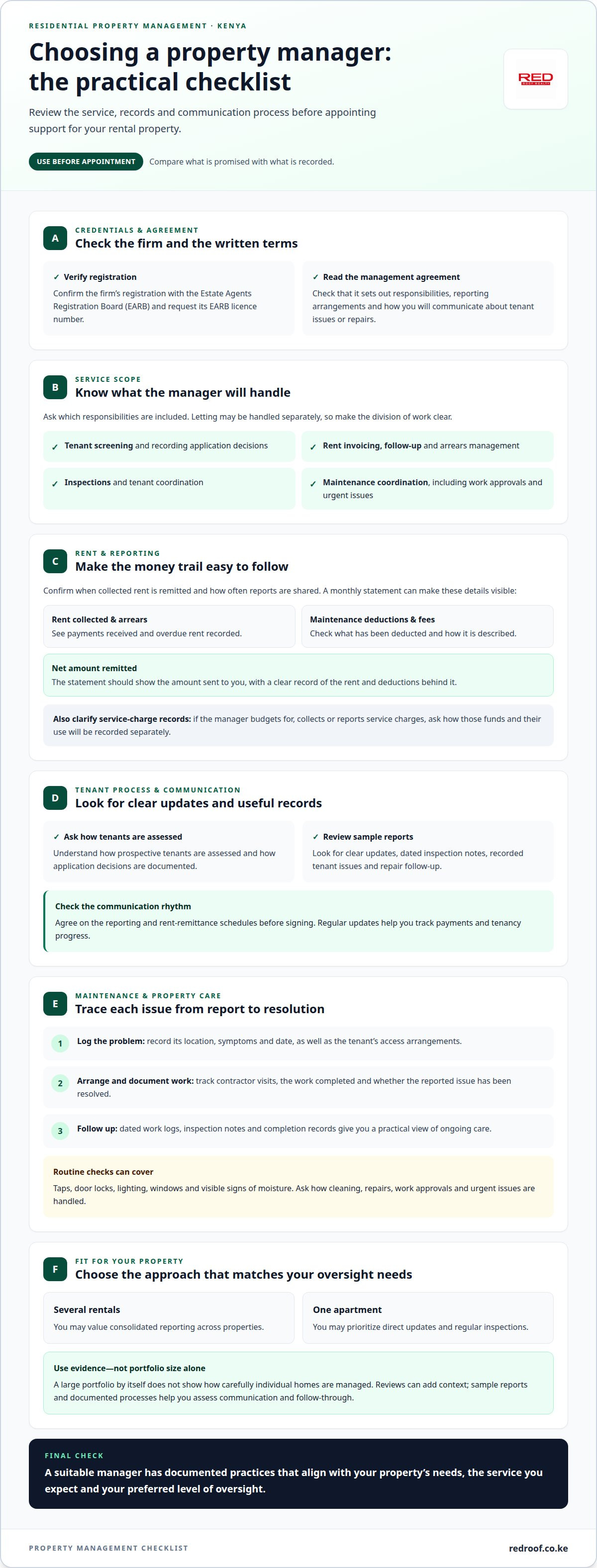
Assess a manager by their reporting, tenant processes and service scope. Ask how rent invoicing, follow-up and arrears management are handled. A clear process shows how overdue rent is recorded and communicated. Confirm when collected rent is remitted and what the owner’s statement records. Monthly statements can show rent collected, arrears, maintenance deductions, fees and the net amount remitted.
Consider portfolio size alongside reporting standards. A large portfolio alone does not show how carefully individual homes are managed. Reviews can offer context, while sample reports show whether updates are clear. Look for practical details such as dated inspection notes, recorded tenant issues and repair follow-up. These records help you assess how the manager communicates and tracks work.
- Confirm which tasks are included, such as tenant screening, inspections, and maintenance coordination.
- Clarify reporting and rent-remittance schedules before signing the management agreement.
- Ask how prospective tenants are assessed and how application decisions are recorded.
Registration matters when assessing a real estate firm in Kenya. Confirm its registration with the Estate Agents Registration Board (EARB), and request its EARB licence number. This gives you a concrete detail to review before appointing the firm. Read the management agreement carefully, too. It should set out responsibilities, reporting arrangements and how the parties communicate about tenant issues or repairs.
Match the manager’s approach to your property and priorities. A landlord with several rentals may value consolidated reporting, while an owner of one apartment may prioritize direct updates and regular inspections. Review examples of reports and tenant-management processes. A suitable manager has documented practices that align with the service you expect, your property’s needs and your preferred level of oversight.
Property Valuation and Management Services
A property valuation gives you an assessment of a home’s value at a particular point. It can inform decisions about holding, selling or reviewing a rental strategy. The assessment may consider location, property type, condition, layout and available market evidence. Management records add useful context, including occupancy history, completed maintenance and the property’s current presentation.
Valuation and management answer different questions. A valuation assesses the property; management coordinates its day-to-day operation. For example, an owner considering a sale can use an assessment alongside tenancy records to understand both the asset and its rental history. An owner retaining the home can use valuation insights when reviewing longer-term plans, while management continues to handle tenant communication and property oversight.
Maintenance records can also help explain a property’s condition during an assessment. A log of roof repairs, plumbing work, or refreshed shared areas gives a clearer account than recollection alone. Managers can keep inspection notes and work records organized for the owner. These documents do not replace an independent valuation, but they help present relevant property information in an orderly way.
For a rental apartment in Nairobi, an owner might review a valuation when assessing whether the property still suits their investment goals. The manager’s records can clarify occupancy, reported issues and completed work. Together, these perspectives support informed decisions without confusing assessed value with rental performance. Property Valuation provides the assessment, while Property Management supports ongoing operations. Keeping the roles distinct helps you understand what each service contributes to your property decisions.
Red Roof Realty: Residential Property Sales
Red Roof Realty offers Property Management for owners who want professional support with residential rentals. It can be a suitable option when tenant coordination, rent administration, property oversight, and clear reporting are priorities. The appropriate arrangement depends on your property and the responsibilities you want managed. Define those responsibilities at the outset so the service aligns with your ownership goals.
Property Management is relevant when you need ongoing support for an occupied home or rental property. Discuss the management scope, reporting expectations, tenant communication and maintenance coordination as part of the arrangement. Clear expectations help you understand how the service fits your property, how information will be shared and which decisions remain yours as the owner.
If you are preparing to buy or sell a home, Residential Property Sales may better match your immediate objective. The focus is the property transaction, rather than ongoing tenancy administration. Consider what you need next: support with a sale, guidance while pursuing a purchase, or continued management of a rental. Identifying that priority helps focus the conversation on the relevant service.
Property Management and Residential Property Sales address different needs. Sales relates to a purchase or sale, while management supports an occupied rental. Consider whether your current priority is a property transaction or ongoing tenancy administration. This distinction can help focus your discussion on the service that fits your property needs.
Red Roof Realty’s residential property services give you options for sales and management. If you are ready to discuss your property needs, contact Red Roof Realty at a time that suits you.
Frequently Asked Questions
What should a monthly statement show?
A useful statement identifies the property and reporting period, then makes each recorded transaction traceable to a supporting record. For example, a payment reference can help match a bank entry to a tenant account. The statement should also distinguish confirmed entries from unresolved discrepancies. This creates a clearer audit trail for reviewing records later or preparing information for an accountant.
What services do residential property management companies in Kenya provide?
A management arrangement can cover more than routine tenancy administration, including lease renewals, move-in coordination and move-out documentation. For a furnished apartment, an inventory of supplied items can help record their condition at occupancy and departure. Responsibilities depend on the written agreement. Clarifying how renewals and tenancy transitions are handled helps prevent gaps when a resident leaves or a new agreement begins.
How are property management arrangements structured in Kenya?
Management arrangements vary with the property, required oversight and agreed responsibilities. The written agreement should distinguish ongoing management from separate assignments, such as placing a new tenant. It should also set out the reporting cycle, approval process and work included. This helps you understand the scope before appointing a manager, without assuming every residential arrangement covers the same tasks.
What should you look for in a reliable residential property manager in Kenya?
Look for continuity and accountability in the manager’s working process. Establish how an unresolved tenant complaint moves from initial report to decision, and who records the outcome. Clarify how the manager shares important correspondence and preserves tenancy documents. A defined handover process is also useful if management responsibility changes, since it helps prevent open matters from being overlooked.
What risks should Kenyan landlords consider when hiring a property manager?
Delegating access and tenant communication can create uncertainty if authority is poorly defined. A manager might receive a repair request while you expect to approve the work first. Set out decision limits, access arrangements and record ownership in writing. Also consider how tenant correspondence and pending matters will be transferred if the management relationship ends, so essential information remains accessible.
How are repairs, maintenance, and emergency issues managed for rental homes in Kenya?
For each repair, a clear work order can record the reported problem, access arrangements, approved action and completion status. For example, if a tenant is available only at an agreed time, record the access arrangement before a contractor visit. Define how urgent reports are escalated and how completion is documented. These details reduce confusion among tenants, owners and people carrying out repairs.

Frequently Asked Questions
A useful statement identifies the property and reporting period, then makes each recorded transaction traceable to a supporting record. For example, a payment reference can help match a bank entry to a tenant account. The statement should also distinguish confirmed entries from unresolved discrepancies. This creates a clearer audit trail for reviewing records later or preparing information for an accountant.
A management arrangement can cover more than routine tenancy administration, including lease renewals, move-in coordination and move-out documentation. For a furnished apartment, an inventory of supplied items can help record their condition at occupancy and departure. Responsibilities depend on the written agreement. Clarifying how renewals and tenancy transitions are handled helps prevent gaps when a resident leaves or a new agreement begins.
Management arrangements vary with the property, required oversight and agreed responsibilities. The written agreement should distinguish ongoing management from separate assignments, such as placing a new tenant. It should also set out the reporting cycle, approval process and work included. This helps you understand the scope before appointing a manager, without assuming every residential arrangement covers the same tasks.
Look for continuity and accountability in the manager’s working process. Establish how an unresolved tenant complaint moves from initial report to decision, and who records the outcome. Clarify how the manager shares important correspondence and preserves tenancy documents. A defined handover process is also useful if management responsibility changes, since it helps prevent open matters from being overlooked.
Delegating access and tenant communication can create uncertainty if authority is poorly defined. A manager might receive a repair request while you expect to approve the work first. Set out decision limits, access arrangements and record ownership in writing. Also consider how tenant correspondence and pending matters will be transferred if the management relationship ends, so essential information remains accessible.
For each repair, a clear work order can record the reported problem, access arrangements, approved action and completion status. For example, if a tenant is available only at an agreed time, record the access arrangement before a contractor visit. Define how urgent reports are escalated and how completion is documented. These details reduce confusion among tenants, owners and people carrying out repairs.